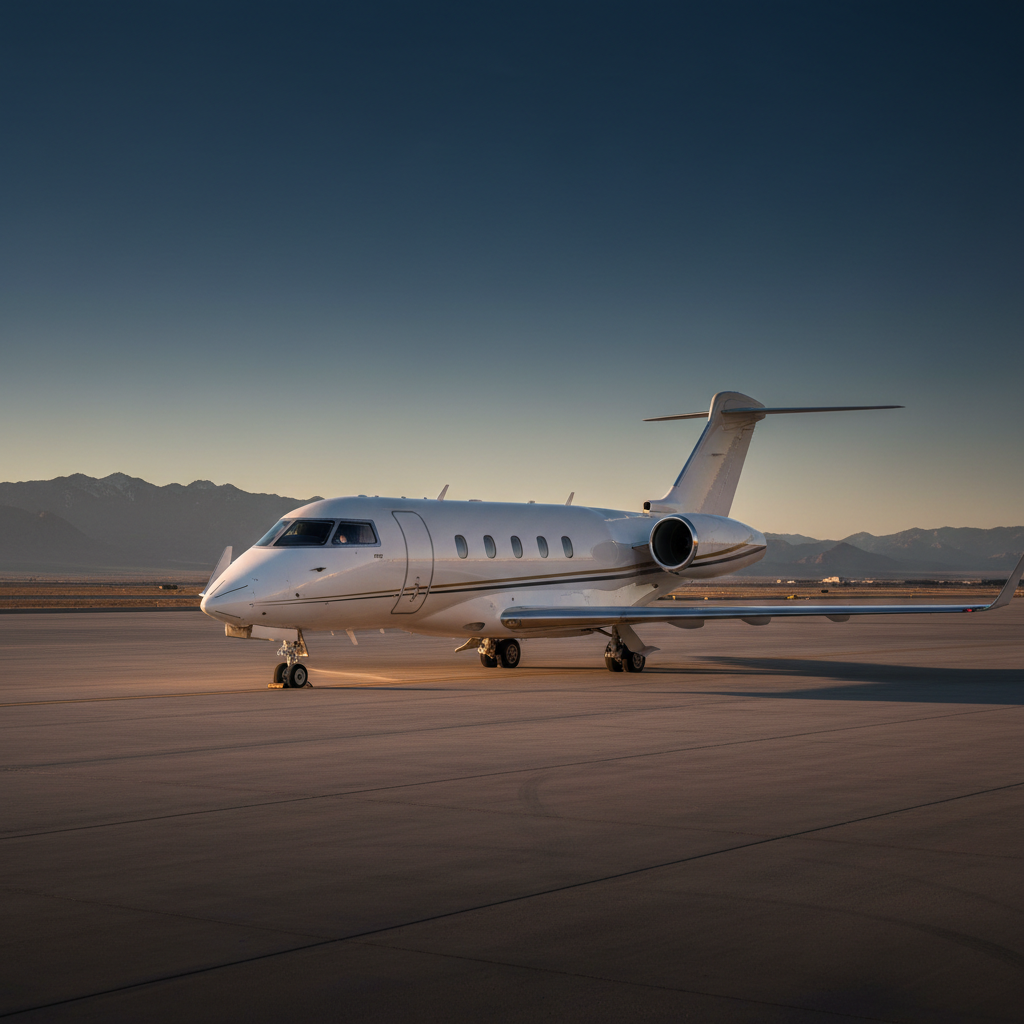
Bombardier Challenger 650: A Broker's Perspective
Overview
The Challenger 650 isn't an aircraft that screams for attention. It's a quiet professional. Launched in 2015, this jet is the culmination of decades of refinement on the Challenger 600 series airframe, one of the most successful large-cabin platforms ever built. Bombardier didn't reinvent the wheel here; they perfected it. The 650 is an evolution of the Challenger 605, featuring more powerful engines, a completely revamped flight deck, and a redesigned cabin.
This is a workhorse, a staple of Fortune 500 flight departments and top-tier charter operators. Why? Because it delivers a class-leading wide cabin, transcontinental range, and predictable, manageable operating costs. It’s not the fastest jet in its category, nor the longest-legged, but it represents a market-proven sweet spot of capability, comfort, and cost-effectiveness. In a market often driven by emotion, the Challenger 650 is a decision made with a spreadsheet and a clear understanding of mission requirements. It’s built for reliability, not ramp presence, though its commanding stance is certainly not subtle.
Production & Variants
The Challenger 650 is a direct descendant of a long and storied line. The original Challenger 600, designed by Bill Lear, first flew in 1978. This led to the 601, 604, and 605, each version bringing incremental but significant improvements in range, performance, and cockpit technology.
The 650 replaced the 605 on the production line in 2015. While they share the same type certificate, the 650 introduced critical upgrades that justify it as a distinct model:
- Engines: The most significant upgrade is the switch to General Electric CF34-3B MTO (Maximum Take-Off) engines. These provide a 5% increase in takeoff thrust over the 605's CF34-3Bs, resulting in improved short-field performance and a higher payload capacity out of challenging airports.
- Avionics: The Rockwell Collins Pro Line 4 avionics of the 604/605 were replaced with the state-of-the-art Bombardier Vision flight deck, which is based on Rockwell Collins Pro Line 21 Advanced. This brought the flight deck to the same level as Bombardier's Global-series jets, featuring four large LCD screens, MultiScan weather radar, and full Synthetic Vision System (SVS) capabilities. It’s a major leap in situational awareness and pilot workload reduction.
- Cabin: The cabin was redesigned with an updated Collins Venue Cabin Management System (CMS), larger galley, and wider seats. These weren't just cosmetic tweaks; they were functional upgrades that improved the passenger experience and aligned the 650 with contemporary expectations for a large-cabin jet.
Production has been steady since its introduction, with Bombardier delivering dozens of units per year. Unlike some of its competitors, there are no major variants of the 650; it is a single, refined product. The primary differentiation between individual aircraft on the market comes down to cabin configuration, optional avionics (like the Head-Up Display), and maintenance program enrollment.
Real-World Performance
The spec sheet says 4,000 nautical miles. In the real world, that means you can comfortably fly New York to London, Dubai to Singapore, or São Paulo to Miami. Planning for 8 passengers and standard NBAA IFR reserves, a more realistic maximum range is around 3,800 nm, especially when flying west against winter headwinds. This isn't a true globe-trotter like a Global 6000, but it covers 95% of the city pairs a typical corporation or high-net-worth individual requires.
The key performance enhancement over its predecessor is takeoff performance. The uprated CF34-3B MTO engines allow the 650 to depart from shorter runways at higher weights. The required balanced field length at max takeoff weight is 5,640 feet. This opens up access to airports like Teterboro (TEB) on a hot day with a full load, or Aspen (ASE) with more payload than a 605 could manage.
Its Mach 0.85 a high-speed cruise of 488 knots is respectable, but most operators will pull the throttles back to a long-range cruise speed of Mach 0.74 (around 424 knots) to maximize fuel efficiency and easily achieve the advertised range. Climb performance is solid; it can reach a cruising altitude of 41,000 feet in under 25 minutes.
Cabin Experience
This is the Challenger’s signature feature: the cabin width. At 8 feet 2 inches wide (7 feet 11 inches at the floor), it’s the widest in its class, a title it has held for decades. This width creates a sense of space that no competitor can match. It allows for wider seats, a wider aisle, and a more open, airy feel.
The standard configuration seats 12 passengers in a double-club arrangement. A popular alternative is a 9-seat configuration featuring a four-seat club, a conference grouping opposite a credenza, and a three-place divan in the aft cabin. The seats are fully-berthable, converting into beds for overnight flights.
The Collins Venue CMS is a significant improvement over the older systems in the 605. It’s faster, more intuitive, and provides passengers with seamless control over lighting, temperature, and entertainment via personal devices or bulkhead-mounted touchscreens. High-speed Ka-band internet is a common and highly recommended option for any buyer today.
The forward galley is large and well-equipped, capable of supporting complex meal services with a microwave, high-temperature oven, and ample cold storage. The aft lavatory is also spacious and serves as the primary access point to the 115-cubic-foot baggage compartment, which can be accessed in-flight.
One critique is the cabin height. At exactly 6 feet tall, it can feel a bit restrictive for taller individuals compared to some newer-design fuselages.
Market Value Today (2026 Estimate)
The Challenger 650 is a known quantity, and its market values reflect that. There is no speculative frenzy here, just a stable depreciation curve based on age, time, and condition. For a 2026 market, expect prices to have softened from their post-2021 peaks.
- High-End: $26,000,000. This gets you a late-model (2021-2023) aircraft with very low time, one private owner since new, desirable options like the HUD/EVS, Ka-band internet, and fully paid-up engine and airframe programs.
- Mid-Market: $22,000,000. This is the core of the market. Expect a 2017-2019 vintage aircraft with standard hours (2,500-4,000 hours), good maintenance history, and enrollment on programs. It may have come out of a fleet, which isn't a negative as long as the records are impeccable.
- Low-End: $18,000,000. Here you’ll find the earliest 2015-2016 models, likely with higher time, perhaps operated in a charter fleet. These aircraft are still perfectly sound, but you must budget for a potential engine overhaul, paint and interior refurbishment, and avionics upgrades. A pre-purchase inspection is critical at this level to identify any deferred maintenance.
Supply is generally stable. Many 650s are held in large corporate fleets and are traded methodically. The best values are often found with private owners who are upgrading.
Operating Costs (2026 Estimate)
Predictability is the 650's middle name. There are few surprises when it comes to the cost of ownership, provided the aircraft is on programs.
Annual Fixed Costs: Approximately $950,000. This includes:
- Crew Salaries/Training: $400,000 (2 pilots, 1 flight attendant)
- Hangarage: $150,000 (varies wildly by location)
- Insurance: $100,000
- Avionics & Database Subscriptions: $50,000
- General Maintenance & Admin: $250,000
Hourly Variable Costs: Approximately $4,800 per hour, based on 450 hours per year. This includes:
- Fuel: $2,800/hr (assuming $5.50/gallon and a 2,050 lbs/hr average burn)
- Engine & APU Programs: $1,200/hr (JSSI/MSP Gold)
- Airframe Program (Smart Parts): $550/hr
- Consumables/Catering/Landing Fees: $250/hr
Total Annual Budget (450 hours): $950,000 (Fixed) + (450 hours * $4,800/hr) = $3,110,000
This translates to a cost per hour of approximately $6,911.
Maintenance Programs
Do not walk, run, from a Challenger 650 that is not enrolled on maintenance programs. The financial exposure is too great.
- Engines: The GE CF34-3B MTO engines are exceptionally reliable, but a major overhaul can cost well over $2 million per engine. Most are enrolled on a comprehensive program like JSSI or GE’s own OnPoint. This turns a potentially crippling capital expense into a predictable hourly operating cost. During a pre-purchase, you must verify the contract terms and ensure there are no buy-in fees or pro-rata charges for the next owner.
- APU: The Honeywell GTCP 36-150 APU should be covered under a program like Honeywell’s MSP Gold. APU maintenance is often overlooked but is crucial for ground operations and as a backup power source.
- Airframe & Avionics: This is critical. Bombardier’s Smart Parts program is essential for managing the cost of components. It covers the repair or replacement of thousands of parts for a fixed hourly rate. An aircraft not on Smart Parts can generate enormous, unexpected invoices for a single avionics box failure. Verifying an aircraft