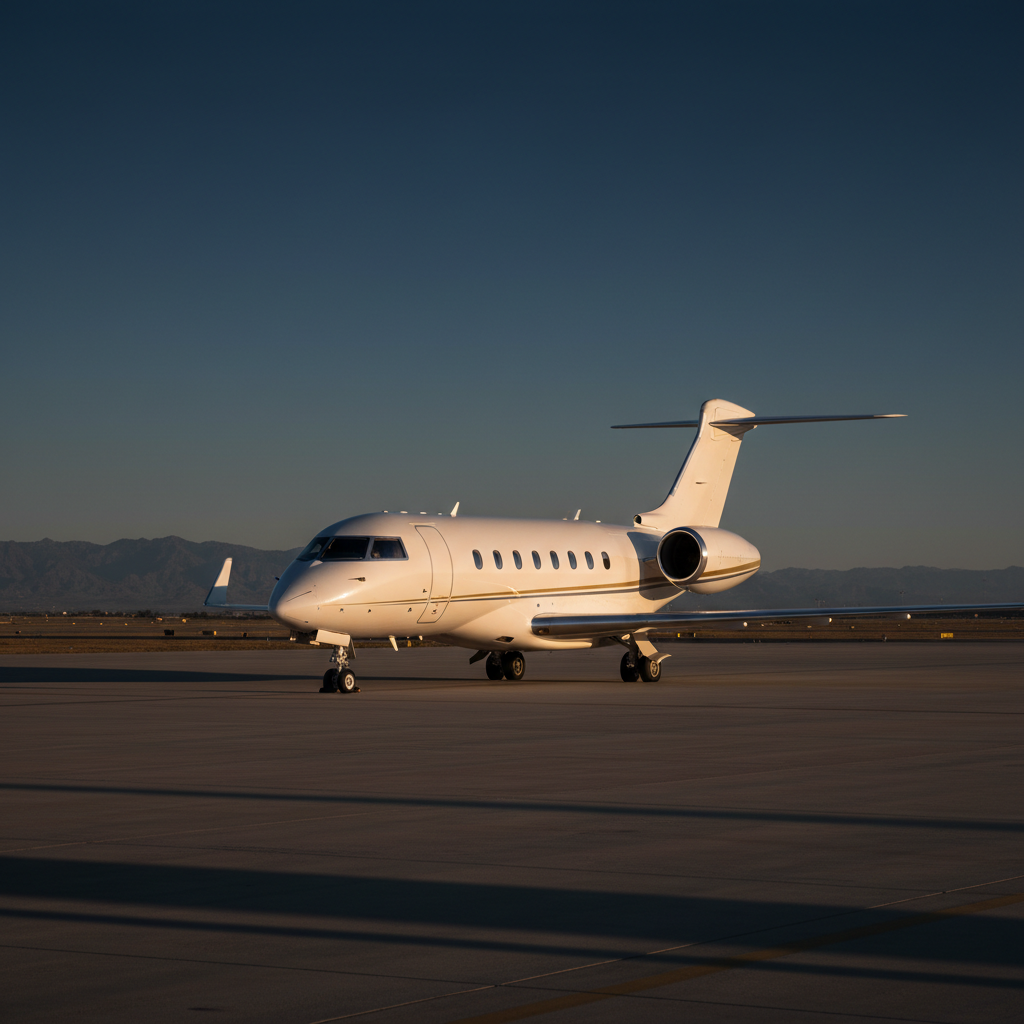
Overview
The Bombardier Global 6000 is a known quantity. It took the proven airframe of the Global Express XRS, added the Rockwell Collins Fusion-based Vision flight deck, and refined the cabin. Produced from 2012 to 2018, it established itself as a workhorse in the ultra-long-range category, delivering a reliable 6,000 nm range and a four-zone cabin that remains one of the most spacious in its class.
For a buyer in the 2026 market, the Global 6000 represents a strategic acquisition. It delivers 95% of the capability of its 6500 successor for a fraction of the capital cost. It's an aircraft for an owner who needs to connect continents, values cabin volume, and prefers a proven platform over the latest model. The key when buying is a thorough pre-purchase inspection (PPI) with a deep dive into engine status, avionics, and program enrollments.
Production & Variants
The Global 6000 wasn't a clean-sheet design; it was an evolution. It directly replaced the Global Express XRS, carrying over the same fuselage and the robust Rolls-Royce BR710A2-20 turbofans. The significant change was in the cockpit. The introduction of the Bombardier Vision flight deck, built on the Rockwell Collins Pro Line Fusion suite, was a major step forward from the XRS's Honeywell Primus 2000XP. This gave the 6000 a modern avionics platform with features like synthetic vision on the head-up display (HUD).
Approximately 338 Global 6000s were delivered before production transitioned to the Global 6500 in 2018. The 6500 introduced new, more efficient Rolls-Royce Pearl 15 engines and further avionics enhancements, but the core airframe and cabin dimensions remained largely the same. This lineage means the 6000 benefits from a mature service network and a deep well of operational knowledge. There are no major variants of the 6000 itself, only incremental software and service bulletin updates over its production run.
Real-World Performance
Bombardier advertises a 6,000 nm range, and for once, the marketing holds up. With a standard passenger load of 8 and flying at Mach 0.85, the aircraft can reliably connect city pairs like New York to Dubai or London to Singapore. A more aggressive high-speed cruise at Mach 0.88 is possible, but expect range to decrease by about 10-12%.
Takeoff performance is strong for an aircraft of this size. Balanced field length is 6,476 feet at sea level and standard conditions. This opens up airports like Teterboro or London City, though payload may be restricted from the latter. Time to climb to an initial cruise altitude of FL410 is typically around 20 minutes.
Its service ceiling is 51,000 feet, allowing it to fly above most weather and commercial traffic, often resulting in more direct routing and lower fuel burn. The Rolls-Royce BR710 engines are a known entity—powerful, reliable, and well-supported, though their maintenance costs are a critical factor in any ownership budget.
Cabin Experience
The Global 6000’s cabin is its defining feature. With a length of 43.25 feet (from the cockpit divider to the aft pressure bulkhead) and a height of 6.25 feet, it feels more like a small apartment than a business jet. The usable floor space is substantial, which is why it’s laid out in three or four distinct zones.
A typical forward configuration includes:
- Zone 1: Forward galley, often with a high-temperature oven, microwave, and espresso machine, opposite a dedicated crew rest area and forward lavatory.
- Zone 2: A four-place club seating arrangement.
- Zone 3: A conference grouping with four seats around a table, opposite a credenza housing entertainment systems and storage.
- Zone 4: An aft stateroom with a three-place divan (certified for two on takeoff and landing) opposite two individual seats. This area, along with the adjacent full aft lavatory (often with a shower option), can be closed off for privacy.
The 19 large windows, significantly bigger than those on its predecessor, allow for ample natural light. Cabin altitude is kept to a comfortable 4,500 feet at FL450, reducing fatigue on long-haul flights. The baggage compartment is a cavernous 195 cubic feet and is accessible in-flight, a critical feature for long-duration trips.
Market Value Today (2026 USD)
The market for the Global 6000 is mature and stable. There is consistent demand from corporate flight departments and high-net-worth individuals upgrading from smaller aircraft or seeking a more cost-effective alternative to a new ultra-long-range jet.
- Low End: $22,500,000. This represents an early model (2012-2013) with higher time (5,000+ hours), engines approaching their 10-year overhauls, and an older interior. It will likely require some investment in avionics upgrades and cabin refurbishment.
- Mid-Market: $25,000,000. For this price, you should expect a 2014-2016 vintage aircraft with 3,000-4,000 hours, engines fully enrolled on RRCC, and a clean maintenance history. The interior will be in good condition.
- High End: $28,000,000+. This is the territory of late-model (2017-2018), low-time (under 2,000 hours) aircraft with desirable features like Ka-band internet, a pristine original interior, and no upcoming major maintenance events. These aircraft are direct competitors to new, smaller-cabin jets.
The supply is steady, with a consistent number of aircraft on the market at any given time. The trend is stable; this is not an asset that will see rapid appreciation, but its depreciation curve has flattened considerably. Its value retention is strong, thanks to its capabilities and the high cost of new replacements.
Operating Costs (2026 USD)
Ownership of a Global 6000 involves significant, but predictable, costs. For budgeting purposes, based on a typical 400-hour annual utilization, the numbers break down as follows:
Annual Fixed Costs: ~$1,250,000
- Crew Salaries & Training: $550,000 (Two pilots, one flight attendant, including annual recurrent training)
- Hangar: $200,000 (Varies widely by location)
- Insurance: $150,000 (Hull and liability)
- Avionics & Database Subscriptions: $75,000
- General Administration: $275,000 (management, scheduling, etc.)
Hourly Variable Costs: ~$9,200/hour
- Fuel: $4,500/hour (Based on an average burn of 3,000 lbs/hr at ~$3/gallon)
- Engine Program (RRCC): $2,500/hour (for both engines)
- APU Program: $300/hour
- Airframe & Component Programs (Smart Parts): $1,200/hour
- General Maintenance & Consumables: $700/hour
This results in an all-in cost per hour of approximately $12,325, assuming 400 hours of flight time per year. The single most important factor in controlling variable costs is enrollment on comprehensive maintenance programs.
Maintenance Programs
A Global 6000 without full program coverage is a significant financial risk. When evaluating an aircraft, the status of these enrollments is as important as the airframe’s total time.
- Engines: Rolls-Royce CorporateCare (RRCC) is the gold standard for the BR710 engines. It covers all scheduled and unscheduled engine maintenance, including the expensive 10-year/4,000-hour overhauls. An aircraft without RRCC will be valued significantly lower and will be much harder to resell. JSSI offers an alternative, but RRCC is preferred by most operators and financiers.
- APU: Similar programs exist for the Honeywell RE220[GX] APU, most commonly from Honeywell’s MSP Gold or JSSI.
- Airframe & Components: Bombardier’s Smart Parts program is essential. It covers a vast catalog of components, from avionics to actuators. There are different levels of coverage (Smart Parts, Smart Parts Plus, Smart Parts Preferred), so a buyer must verify which specific parts are included. An aircraft with comprehensive Smart Parts coverage avoids the risk of multi-hundred-thousand-dollar bills for unexpected component failures.
- Airframe Structure: Bombardier FalconCare is a program that covers scheduled airframe maintenance labor. It is less common but adds value and predictability for larger fleet operators.
Common Pre-Purchase Findings
A PPI on a Global 6000 must be conducted at a facility with deep experience in the model. Beyond the standard checks, focus should be on:
- BR710 Engine LLP Status: Life-Limited Part (LLP) back-to-birth traceability is non-negotiable. Discrepancies in records can render an engine essentially worthless. The inspection should verify the remaining life on all major rotating components against the engine records.
- Vision Flight Deck Status: Check the status of all software updates and service bulletins. Upgrading the Fusion avionics can be costly if the aircraft is behind on key updates like FANS 1/A+, CPDLC, and ADS-B Out.
- Smart Parts Coverage Gaps: A key task is to get a full report from Bombardier on what serial numbers are and are not covered under the Smart Parts contract. It’s common to find that a previous owner opted out of covering certain high-cost items, like landing gear or specific avionics boxes.
- Paint & Interior Condition: The original paint and interior from 2012-2015 will be showing their age. A full strip and repaint costs upwards of $300,000, and a full interior refurbishment on a four-zone cabin can easily exceed $1,500,000. These are major negotiating points.
- Corrosion: Check for corrosion in the typical areas—under the galley and lavatories, and around antennas. While the Global airframe is robust, neglect can lead to expensive structural repairs.
Mission Fit
The Global 6000 is built for one primary mission: connecting global business centers with a team of executives. It is the perfect tool for a company that needs to move 6-10 people from the US to Asia, Europe to South America, or the Middle East to the US, all without a fuel stop.
The four-zone cabin allows for simultaneous work, dining, and rest. One group can hold a meeting in the conference section while another passenger sleeps in the aft stateroom. This level of utility is its core strength. It is overkill for domestic trips, where a Challenger or Praetor would be more efficient, but for any mission that pushes beyond 8-10 hours, the Global 6000 comes into its own.
Comparable Aircraft
- Gulfstream G550: This is the Global 6000’s most direct competitor. The G550 has a slight range advantage and the iconic Gulfstream oval windows. However, its cabin is narrower and typically has a three-zone layout. The Global 6000 offers more cabin volume, which is a significant factor for many buyers. The G550’s production ended earlier, making the 6000 a newer platform on average.
- Dassault Falcon 7X: The 7X offers similar range and outstanding short-field performance thanks to its three-engine design. Its cabin is slightly smaller than the Global 6000’s, and its operating costs are very competitive. Buyers who prioritize performance and efficiency might lean toward the 7X, while those who prioritize cabin space will prefer the Global. The 7X cockpit is also highly regarded by pilots.
Madison's Take
The Global 6000 is a smart buy in the current market. It offers the cabin size and range of current-production aircraft for a 50-60% discount. As long as you verify full engine and parts program enrollment and budget for a potential interior refresh, you are acquiring a proven, intercontinental workhorse whose value will hold steady. This is one of the best large-cabin, long-range values out there today.