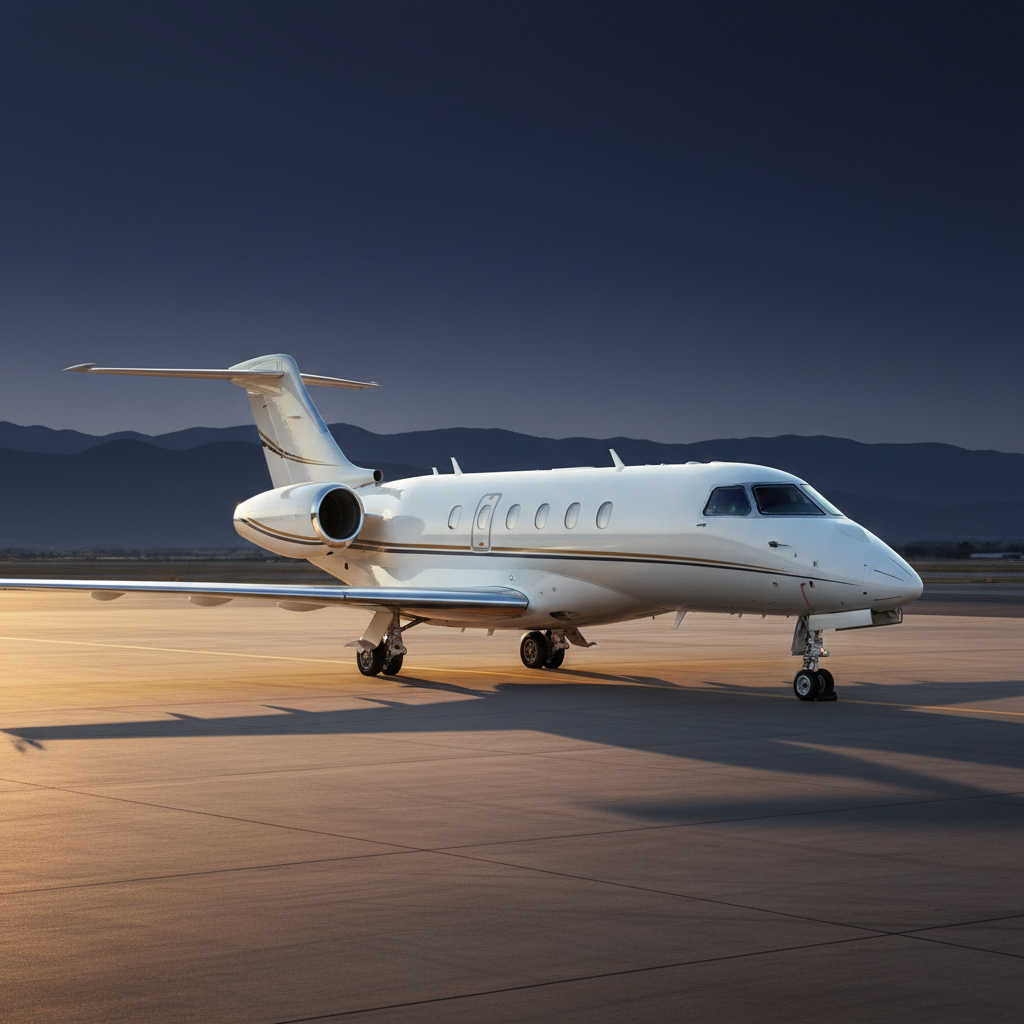
Embraer Legacy 650: A Broker's Perspective
Overview
The Embraer Legacy 650 is a direct response to a market need: trans-Atlantic range in a robust, proven airframe without the acquisition cost of a clean-sheet, purpose-built large-cabin jet. Produced from 2010 to 2020, the 650 is an evolution of the successful Legacy 600, itself derived from the ERJ-135 regional jet. This lineage gives the 650 a unique combination of airliner-grade reliability and corporate jet functionality.
The key upgrade over the 600 is range. By adding a ventral fuel tank and strengthening the wing, Embraer pushed the 650's legs to 3,900 nautical miles, a significant jump that unlocked non-stop flights like London-New York or Singapore-Sydney under the right conditions. It retains the 600's cavernous cabin, offering three distinct zones in a package that competes directly with aircraft like the Bombardier Challenger 605, often at a more compelling price point.
For a buyer focused on cabin volume, proven systems, and continent-hopping capability, the 650 represents a logical and high-value proposition. It’s a workhorse, not a status symbol, designed for principals who value productivity and reliability over ramp presence.
Production & Variants
The Legacy 650's production run began in 2010, building on the foundation of the 600 which had been in service since 2002. The airframe’s deep roots in the Embraer Regional Jet (ERJ) family mean that its core systems, structures, and flight characteristics were well-understood from day one. Over its decade-long run, approximately 100 units were delivered.
In 2016, Embraer introduced the Legacy 650E. The 'E' stands for 'Evolution,' and this variant brought several key upgrades to the platform, primarily in the cockpit and cabin. The 650E came standard with a synthetic vision system (SVS) and autothrottles, reducing pilot workload and enhancing situational awareness. Previously, these were optional or unavailable. The cockpit was updated with the Honeywell Primus Elite avionics suite. The 650E also included a redesigned three-zone cabin with more refined styling and new seating options. A notable commercial feature of the 650E was its unprecedented 10-year or 10,000-flight-hour warranty, a bold statement of confidence in the platform's reliability.
From a buyer’s perspective, a 650E is a more desirable aircraft due to these standard enhancements. However, many earlier 2010–2015 models have been retrofitted with the Primus Elite avionics, closing the gap in cockpit capability. The core airframe, engines, and performance metrics between the standard 650 and the 650E remain identical.
Real-World Performance
Official marketing materials tout a 3,900nm range. In the real world, this holds up for missions with four passengers under NBAA IFR reserves. This capability makes city pairs like Dubai to London, São Paulo to Miami, or Moscow to Beijing achievable non-stop. For trans-Atlantic crossings from Western Europe, the 650 is dependable. A flight from New York to Paris is pushing the aircraft to its limit and would require favorable winds.
Its cruise speed is not a standout feature. Expect a high-speed cruise around Mach 0.80 (459 knots) and a long-range cruise closer to Mach 0.78. Competitors like the Gulfstream G450 are faster. The trade-off is fuel efficiency; the Rolls-Royce AE3007A2 engines are relatively economical for an aircraft of this size.
Takeoff performance is adequate but not exceptional. At max takeoff weight (53,572 lbs), it requires 5,741 feet of runway at sea level. This means it can operate comfortably out of most primary and secondary airports, but it won’t be accessing short-field destinations like Aspen or London City Airport. Its airliner DNA is apparent here—it prefers longer runways.
Cabin Experience
The cabin is the 650’s primary selling point. At 1,410 cubic feet, its volume is immense for its price category. The cross-section is identical to the Legacy 600, providing 6 feet of stand-up height and a generous 6.9 feet of width.
The cabin is divided into three distinct zones. A typical configuration includes:
- Forward Zone: A club-four arrangement with executive tables, ideal for meetings.
- Mid-Cabin Zone: A two-place club opposite a four-place divan. This area serves as a conference or dining space.
- Aft Zone: Often configured as a private stateroom with another divan opposite a single seat, or two opposing divans that can be converted into a bed. This zone can be closed off for privacy.
It features a large forward galley, essential for long-haul flights requiring complex meal service. There are two lavatories: a smaller one in the forward cabin for crew or guests, and a full-sized lavatory in the aft. A significant advantage is the 240 cubic foot baggage compartment, the largest in its class, which is fully accessible in-flight.
While luxurious, the interior finish doesn’t quite match the bespoke quality of a top-tier Gulfstream or Dassault. However, it is highly functional, durable, and provides an environment well-suited for both work and relaxation over 7-8 hour flights.
Market Value Today (2026 Estimate)
The market for the Legacy 650 has softened from its post-2020 peak, settling into a more stable, buyer-favorable position.
- Low End: $11,500,000 USD. These are typically early 2010–2012 models, potentially with engines not enrolled on Rolls-Royce CorporateCare, higher airframe time, and original paint/interior showing their age.
- Mid-Market: $13,000,000 USD. This price point secures a well-maintained, mid-life 650 or 650E, fully enrolled on engine and airframe programs, with updated avionics and a good pedigree.
- High End: $14,500,000 USD. Reserved for late-model, very low-time 650E aircraft with pristine interiors, complete program coverage, and a single owner history. These are rare.
Supply & Trend: The on-market supply is moderate, with a handful of aircraft available at any given time. The trend is currently softening. As newer, more efficient models like Embraer’s own Praetor 600 gain traction on the used market, the 650 faces downward price pressure. It represents excellent value in terms of "metal for the money," but it is not an appreciating asset.
Operating Costs (2026 Estimate)
The Legacy 650 benefits from its ERJ heritage with straightforward maintenance and good parts availability.
- Annual Fixed Costs: Approximately $850,000 USD. This covers crew salaries, hangarage, insurance, and basic subscriptions.
- Hourly Variable Costs: Approximately $4,500 USD per flight hour. This figure assumes engine programs, APU programs, and direct costs like fuel and maintenance reserves.
- Fuel Burn: On a typical mission, expect an average fuel burn of around 2,200 pounds per hour (PPH). This breaks down to roughly 2,800-3,000 PPH in the first hour, settling into a cruise burn of 1,800-2,000 PPH.
Based on a typical usage of 400 annual hours, an owner can expect a total annual operating budget in the range of $2,650,000 USD.
Maintenance Programs
Comprehensive program enrollment is critical for preserving the 650's residual value and ensuring predictable maintenance costs.
- Engines: The Rolls-Royce AE3007A2 engines should be enrolled on Rolls-Royce CorporateCare (RRCC) or a comparable program like JSSI. An aircraft without engine coverage is a major liability, as a single unexpected shop visit can exceed $1 million. The key items to track are the engine Life Limited Parts (LLPs).
- APU: The Honeywell 36-150(EMB) APU should also be on a program like JSSI.
- Airframe/Avionics: Embraer offers Embraer Executive Care (EEC), which functions like Bombardier's Smart Parts program, covering a wide range of airframe and avionics components for a fixed hourly rate. While not as universally adopted as engine programs, EEC is a significant asset that smooths cash flow and is highly valued on the resale market.
Common Pre-Purchase Findings
A pre-purchase inspection (PPI) on a 650 is fairly standard, but our experience shows a few key areas that warrant close attention:
- Rolls-Royce AE3007 Engine LLPs: The status of Life Limited Parts is paramount. The PPI must verify the time and cycles remaining on all critical components against the engine records. Any discrepancy can lead to a multi-million dollar exposure.
- Paint & Interior Condition: As a workhorse aircraft, many 650s have seen high utilization. Early models (2010-2013) may still have their original paint and interior, which are likely to be tired. Budgeting for refurbishment ($300,000–$800,000) may be necessary.
- Honeywell Primus Elite Avionics: For pre-650E models, verify if the Primus Elite upgrade has been performed. If not, this is a significant negotiating point, as the upgrade costs several hundred thousand dollars. Check for the specific software version and for proper integration of features like FANS 1/A+ for oceanic operations.
- APU Condition & LCF Count: The APU is critical for ground operations. We look for oil analysis trends and the Low Cycle Fatigue (LCF) count on the turbine wheel. A high LCF count can signal an impending and expensive replacement.
- Corrosion in Regional Jet Heritage Areas: Given its ERJ lineage, inspectors should pay special attention to areas that were common corrosion points on the regional jets, particularly around the galley and lavatory service panels.
Mission Fit
The ideal Legacy 650 buyer is a corporation or individual who needs to move up to 13 passengers over distances of 3,500-3,900nm and prioritizes cabin space and reliability. This user is practical, valuing the three-zone cabin for productivity on the go. They are less concerned with having the fastest or newest aircraft on the ramp and more interested in a proven platform with a global support network.
It’s an excellent fit for companies with regular trans-Atlantic or cross-continent missions that don